




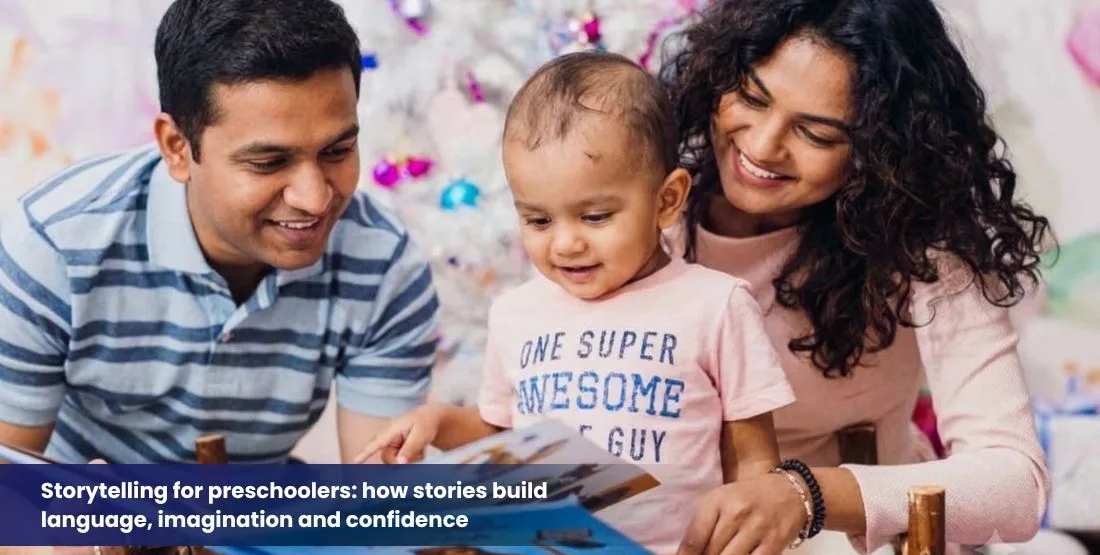
“One more time, please!” If your child asks for the same bedtime story every night, you already know how much little ones love a good tale. Storytelling for preschoolers does far more than fill the time before sleep. It is one of the simplest ways to help a young child grow, and it costs nothing more than your voice and a little attention.
Why is storytelling for preschoolers so important?
The years from two to six are when children learn language faster than at any other time. Stories give them new words, new ideas and a reason to listen closely. Whether a parent tells a folk tale at home or a teacher reads a picture book in class, every story adds to a child’s growing world.
Reading and storytelling to kids also strengthens the bond between adult and child. That warm, shared moment makes children feel safe, and a child who feels safe is ready to learn.
What are the 5 C’s of storytelling?
The benefits of storytelling for children fall into five simple areas. We call them the 5 C’s, and each one supports a different part of your child’s growth.
Communication
Stories fill a child’s world with words they would rarely hear in daily conversation, like “enormous”, “whisper” or “brave”. Hearing a story in more than one language helps even more. Many Vadodara families switch between Gujarati, Hindi and English at home, and a grandparent’s folk tale in Gujarati can teach words a textbook never will.
Creativity
A story gives children a picture to build in their minds. They imagine the dark forest, the clever crow and the giant who lives on the hill. Ask your child to invent a new ending, and watch their imagination take off.
Critical thinking
Pause in the middle of a story and ask, “What do you think happens next?” This simple question makes children predict, reason and connect ideas. Over time, they start asking their own questions, which is the first step towards real problem solving.
Character
Stories provide a mild method of teaching values; a story involving a friend who shares or a boy who tells the truth remains in a child’s mind much longer than a direct lecture. The moral stories told to preschool children convert important lessons such as honesty and kindness into something that children can understand.
Confidence
When children retell a story, act out a character or answer questions about it, they practise speaking up. A shy child who roars like the lion in front of the class gains confidence that carries into every part of their day.
How should parents tell stories to young children?
How a story is told matters as much as the story itself. A flat, rushed reading loses a child’s interest, while a lively telling keeps them hooked. Use your voice, your face and plenty of pauses to bring the story to life.
Voice modulation is especially powerful. A soft, slow voice for a sleepy bear and a loud, happy voice for a birthday party help children recognise different emotions. Your facial expressions add to this, showing what surprise, worry, or joy look like.
A few simple habits make storytelling time richer:
Encourage your child to take part and ask them to make the animal sounds or to repeat a favourite line.
Indicate the pictures and describe what you see.
When they ask, go through the story once more, since repetition aids children in learning new words.
Make it short and enjoyable for toddlers, and then gradually move on to longer stories.
How does storytelling help a child’s brain and future learning?
A child’s brain grows rapidly in the early years, and every conversation and story helps build connections for language and thinking. Research from Ohio State University found that children who are read just one book a day hear about 290,000 more words by age 5 than children who are never read to.
Those extra words make a real difference later. Children with a strong vocabulary often find it easier to learn to read, follow lessons and express themselves at school. In our experience, regular storytelling for preschoolers pays off, because the children who love stories at three are often the ones who love books at eight.
How does Alphakids use storytelling in the classroom?
At Alphakids International, stories are part of everyday life on campus. Our Playgroup uses music, movement and short stories to help toddlers settle in. In Nursery, themed, story-based lessons build early language, and our curriculum includes value stories that teach kindness and good habits.
Our cosy reading library helps children build a love for books from an early age. Teachers trained by our Mumbai head office bring stories to life, and our ASTERIA pedagogy builds IQ, EQ and SQ together. You can read more about how we nurture IQ, EQ and SQ in young children, or try these screen-free activities at home alongside storytime.
Give your child a lifelong love for stories
The right school can turn a love of stories into a love of learning. If you are looking for the best preschool in Vadodara, where every child is encouraged to listen, imagine and speak with confidence, we would love to meet you. Book a visit to our Karelibaug campus or call +91 92279 91016.
“Storytelling for preschoolers” appears 4 times: in the H1, the first paragraph, an H2 and the brain section. “Storytelling to kids” and “best preschool in Vadodara” appear once each. It also works in longer phrases parents search for: benefits of storytelling for children, moral stories for preschoolers and how to tell stories to young children. There are 3 internal links and 1 external link, and the blog has no hyphens or em dashes.
FAQs
Storytelling builds vocabulary, listening skills, imagination and confidence. It also teaches values and strengthens the bond between parent and child, giving young learners a strong foundation for reading and school success.
Yes. Hearing stories in Gujarati, Hindi or English helps children pick up new words naturally. Young children learn languages easily, and stories give them meaningful context for every new word they hear.
Even 10 to 15 minutes a day makes a difference. A short bedtime story every night builds a lasting habit and adds thousands of new words to a child’s vocabulary over time.
Use different voices for characters, pause to ask what happens next, point at pictures and let your child join in with sounds or repeated lines. Keep it short, lively and fun.
Stories are part of everyday life at Alphakids. Playgroup uses short stories to help toddlers settle, Nursery follows themed, story-based lessons, and our reading library helps children grow a love for books.