





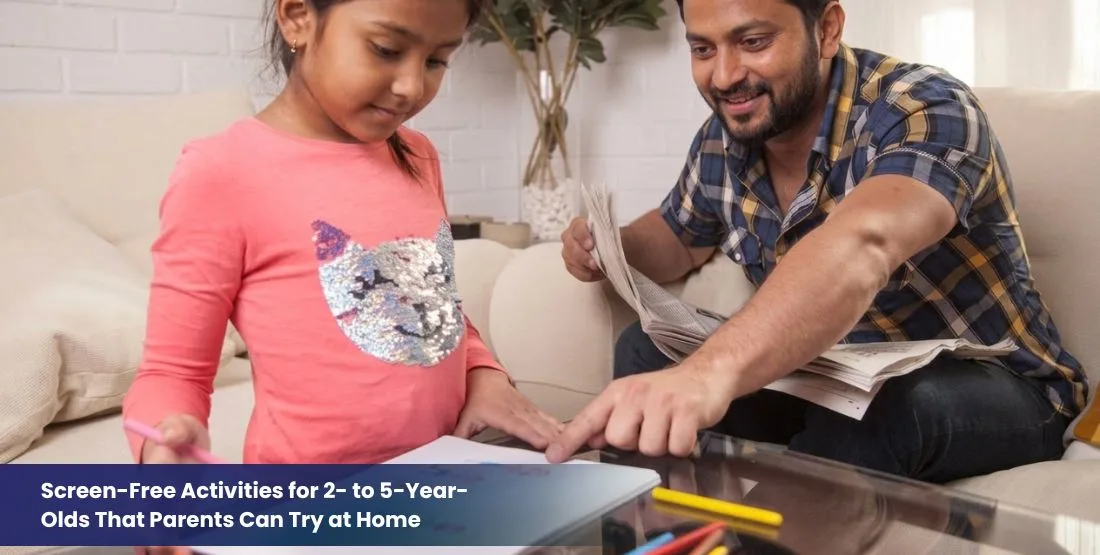
Screens are everywhere now, and young children notice them. A short cartoon or mobile game might appear to be harmless, particularly on a busy day. But if screen time replaces active play, conversations, family time, outdoor activities, or sleep, it can interfere with the healthy habits young children need to grow. The aim is not to get rid of screens altogether but to achieve a better balance.
Why Screen Time Has Become a Real Concern
The World Health Organisation recommends that a child aged two to four have no more than one hour of sedentary screen time per day, with less being preferable. Yet in many homes, screen time is considerably higher, particularly when parents are dealing with work, household duties, and a busy home life.
The effects occur slowly. Children who spend too much time in front of screens tend to develop shorter attention spans, experience slower language development, and have fewer opportunities to build their social skills through actual interaction. Emotional regulation may also be affected, since a screen can replace small, everyday situations where children would normally learn to cope with boredom or frustration on their own.
This doesn’t make technology the enemy; it just shows that young children need a good balance, with plenty of room for genuine, hands-on play.
Simple Activities for Preschool Kids at Home
1. Read a Story Together
Pick a short picture book and let your child turn the pages.
Do not worry about finishing the entire story. Ask simple questions such as, “Where is the dog?” or “What do you think happens next?”
Storytelling helps children listen, understand language, express ideas, and use their imagination. The WHO also recommends reading and storytelling with a caregiver as a valuable alternative during quiet time.
2. Try Simple Sorting Games
Special learning materials are not necessary. You can use common household items, for example, large blocks, coloured cups, socks, or toy cars. Ask your child to group the items by colour, size, or type.
This turns a routine activity into a straightforward learning experience, as children start to notice differences, make choices, and explain what they see.
3. Make Art Without Worrying About the Result
Give your child crayons, paper, washable colours, or age-appropriate clay. Let them draw freely.
A house may look like a circle. A person may have very long arms. That is perfectly fine.
The goal isn’t to create perfect artwork. Children are practising creativity, hand control, decision-making, and self-expression.
4. Get Moving With Indoor Physical Activities
Try simple physical activities for preschoolers such as:
- Dancing to a song
- Walking like different animals
- Jumping over a line
- Balancing along a safe path
- Playing red light and green light
- Throwing a soft ball into a basket
The World Health Organisation suggests that children aged from three to four years should have at least 180 minutes of physical activity daily, including some more intense activity.
Choose activities appropriate for your child’s age, and make sure the area is safe.
5. Let Your Child Help With Simple Tasks
Young children often want to do things on their own. Use that interest.
Let your child put toys away, match socks, arrange books, water plants with supervision, or help set the table.
These small jobs can teach responsibility and independence. They also give children a chance to follow instructions and feel that they are contributing to the family.
6. Spend Time Outdoors
A short walk around the neighbourhood, a visit to a park, or simply playing with a ball outside can be a welcome break from screens.
Outdoor play gives children space to run, observe nature, explore movement, and interact with others. Active play also supports healthy physical development.
For families looking at a pre-primary school in Vadodara, it is worth asking how the school balances classroom learning with play, movement, and exploration.
7. Talk, Ask Questions and Listen
Sometimes the simplest activity is a conversation. Ask your child about their favourite toy. Talk about what they saw outside. Ask them to describe a picture. Let them tell you a story in their own way.
These conversations help children practise language and communication. More importantly, they give children your attention.
Building a Routine Without a Screen
The simplest way to reduce screen time is to replace it with an equally interesting activity, rather than just removing it and hoping for the best. A brief daily routine works well, including fifteen minutes of quiet play after breakfast, some time outdoors in the evening, and a bedtime story instead of a video.
Consistency matters more than perfection here. Even a few structured, screen-free hours each day can make a noticeable difference over a few weeks.
Why This Matters for Long-Term Growth
That’s why a thoughtful pre-primary school in Vadodara focuses heavily on hands-on, screen-free learning during school hours and encourages the same at home. Children who grow up with a healthy mix of active play, creative activities, and real conversation tend to show stronger focus, better emotional balance, and more confidence in social settings later on.
A good pre-primary school in Vadodara doesn’t limit teaching to the classroom; it also advises parents on how to continue that kind of learning at home so development can keep going well after school hours.
Choose a School That Values Real, Hands-On Growth
Children need opportunities to learn from real people and real experiences. This is also an important part of early childhood education.
At Alpha Kids School, children learn through play, activities, interaction, creativity, and exploration. A supportive pre-primary school in Vadodara can complement what parents are doing at home by giving children regular opportunities to learn with teachers and friends.
If you want your child to grow through real play, real conversation, and real connection, consider Alpha Kids School for their early years. Reach out to us today to learn more.
FAQ
Q1. How much screen time is recommended for young children?
The World Health Organization says that children between the ages of two and four should have no more than one hour of sedentary screen time each day, and adds that less is better for healthier physical and mental development.
Q2. What are a few simple activities that toddlers can do without using a screen?
Examples include constructing a blanket fort, sorting objects by colour, playing with playdough, drawing and telling stories. These activities require little preparation and naturally help develop creativity, concentration, and fine motor skills.
Q3. Why is it important for preschool children to be physically active?
Activities such as dancing, hopping, or doing simple obstacle courses help preschool children develop coordination, balance, and strength. They also help burn off excess energy, which can lead to better sleep and a more positive mood.
Q4. What is the best way for parents to cut down on screen time without having to put in daily effort?
Replacing screen time with an engaging activity is more effective than removing it outright. Having a brief daily routine that includes active play, creative time, and storytelling makes the change easier and more sustainable.
Q5. Does cutting down on screen time actually lead to better child development?
Yes, it does; children who spend less time in front of screens and more time in hands-on play tend to develop stronger language skills, have better attention spans, and show improved emotional regulation because they have more real opportunities to think, create, and interact.